

 Energy Management
Water Is The Utility Cost Manufacturers Can’t Afford To Overlook

Electricity and natural gas typically dominate the conversation when manufacturers review utility costs. Water and wastewater, however, are often overlooked despite becoming an increasingly significant operating expense.
Across Canada, municipalities are facing rising infrastructure, treatment and operating costs. At the same time, drought, population growth, industrial development, and data centres are increasing pressure on water resources.
For manufacturers, this means water is becoming an increasingly important utility cost and one that may contain more savings opportunities than expected.
Your Water Bill Is More Than the Meter
Municipalities across Canada are regularly increasing rates. In 2026, Calgary increased its water rate by 6.75%, Surrey's increased approximately 6%, Toronto’s increased by 3.75%, while Vancouver's increased 5.5%. These increases can rival or exceed annual changes in other utility costs.
And unlike natural gas or electricity commodity prices, these costs are often driven by infrastructure investment and municipal cost recovery. That can make higher water, and wastewater rates, a persistent operating-cost issue.
For industrial facilities, the cost of water can extend well beyond the purchase of water itself.
Depending on the municipality and facility, charges may include:
- Water consumption
- Wastewater treatment
- Sewer surcharges
- Industrial wastewater or "over-strength" charges
- Stormwater fees
- Service and meter charges
Are You Paying the Right Rate?
Municipalities may provide specialized industrial rates, conservation programs, rebates or wastewater abatement programs.
Toronto, for example, offers manufacturers an Industrial Water Rate that can reduce the cost of eligible high-volume consumption. The City also operates a Sewer Surcharge Rebate Program where water purchased from the municipality is used on-site but does not enter the sanitary sewer. Water may be incorporated into a product, evaporated through cooling systems, used in boilers, lost through process operations or otherwise removed from the wastewater stream.
Programs differ significantly across Canada, but the principle is consistent:
The biggest opportunity may not always be reducing consumption.
Water Availability Is Becoming a Strategic Issue
Cost isn't the only reason manufacturers should be paying closer attention to water. As governments consider how to allocate increasingly valuable water resources, manufacturers should expect greater attention on water consumption, conservation, and wastewater discharge.
For companies planning facility expansions or new production capacity, water availability could eventually become an infrastructure constraint in much the same way electrical capacity already can.
Water Efficiency Can Improve Sustainability And Reduce Costs
Water conservation is often viewed primarily as a sustainability initiative. For manufacturers, it should also be viewed as a utility-cost opportunity.
The best opportunities may come from process improvements, water reuse, cooling-system optimization, leak reduction or better metering.
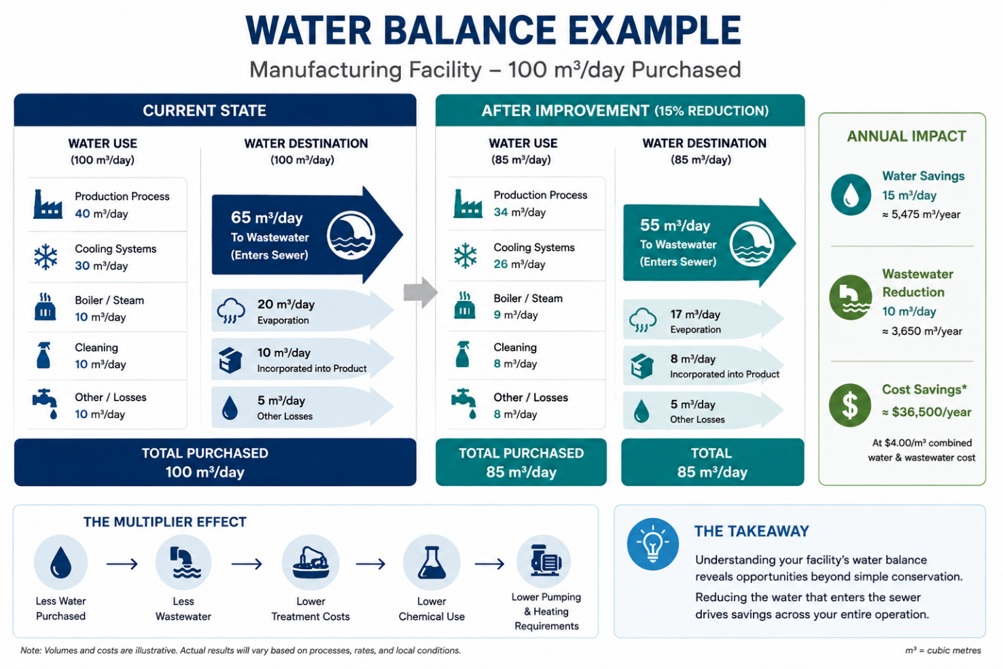
This is why a meaningful assessment should look at the facility's entire water balance, not just the municipal meter.
Treat Water Like a Utility
Manufacturers routinely analyze electricity and natural gas rates, procurement strategies and efficiency opportunities. Water deserves the same level of attention.
A water and wastewater review should ask:
- Are we on the correct municipal rate?
- Are we paying wastewater charges on water that never reaches the sewer?
- Where are our largest consumption opportunities?
- What conservation programs, rebates or incentives are available?
- Could future water availability or regulation affect our operations?
Water may be one of the most overlooked opportunities in your utility portfolio. The first step is understanding what you're currently paying and determining whether you need to be paying it.





 Apr 28, 2026